Attendance Management Plan
Attendance Management Plan Overview:
Regular school attendance is vital for the success and wellbeing of our tamariki. Attending school every day supports our tamariki to build strong foundations for their learning and social development. Regular attendance also promotes achievement success as tamariki are able to consistently build on their learning.
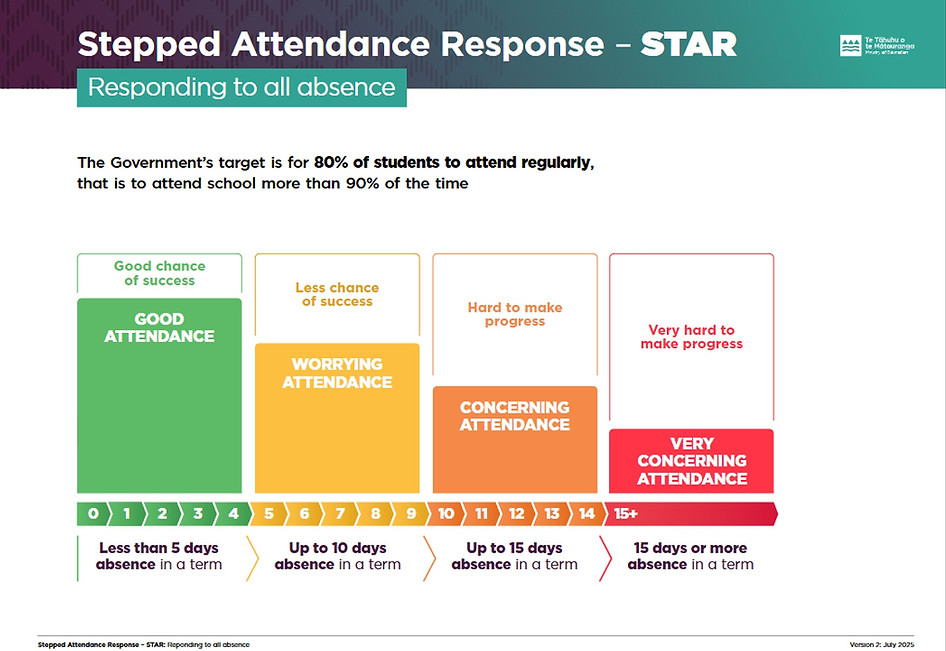
The government has set a national target of 80% of students attending school at least 90% of the time. This means that tamariki should be absent for no more than one day a fortnight to ensure that they can have continued success at school. At Wairoa Primary School, our school values underpin our approach to attendance. Our Stepped Attendance Response outlines our process for monitoring, supporting and improving attendance so every tamaiti can strive to be the best they can be.
Our overall attendance data for the last 3 years shows steady improvement.

However, when we look at a term-by-term trends overview, we can see that we have, on average, around 20% Chronic attendance, and our goal is to reduce this to below 10%.

To achieve the government target of 80% of the children attending 90% of the time by 2030 we plan to increase regular attendance by a minimum of 3% a year.
At Wairoa Primary School, we are developing our Te Ara Marire Framework that encompasses the tikanga and wairua of our kura (both a rumaki and auraki setting); it aligns our teaching, assessment, and strategic planning with Te Marautanga o Aotearoa, and the New Zealand Curriculum.
Wairoa Primary School fosters a nurturing environment where positive behaviour and purposeful learning align, empowering students to excel academically and socially. By implementing evidence-based strategies, the school focuses on building respectful relationships, emotional regulation, and engaging, tailored education to ensure every child thrives.
The 4 Pou, Wairoa, Waiope, Waiora and Wainui upholding all we do.

The Goal: To achieve a school-wide attendance rate of 90%+ by fostering a culture where every student feels a sense of belonging and "Te Ara Marire" (The Peaceful Path).
The Wairoa Primary Way / Te Ara Marire Connection
Safe. Students feel physically and emotionally safe to attend school daily.
Pou Integration:
Wairoa (The River): Representing the "flow" of students into school. Just as a river needs a clear path, our attendance systems remove barriers to coming to school.
Waiora (Wellbeing/Life Force): Using the Waiora pou to frame our Attendance Management Plan not as "truancy tracking," but as a "Wellbeing Check." When a student is absent, we check on their Waiora.
Attendance Management Plan- WellBeing Attendance Plan
Attendance Expectations We regularly communicate with our tamariki and whānau about attendance expectations, consisting of:
-
Communication via EDGE daily if child absent for unknown reason.
-
Weekly school newsletter and regular facebook posts
-
Korero at Whānau hui (Learning Conferences)
-
Korero on enrolment with Principal
-
Facebook reminders
-
Phone calls, from Kaiako for well being checks
-
Personalised emails and messages with whānau when needed
Recording Attendance
Kaiako Responsibilities
1. Roll to be taken by kaiako each morning BEFORE 9.10am.
2. Any tamaiti who arrives late to school is to report to the office to register that they are late on Edge and take a Late Pass back to the class to show the teacher they have reported in.
3. Should a tamaiti arrive in class after the register has been taken, kaiako must ask if they have reported to the office/have a late pass. If they haven’t, they will direct them there.
4. Afternoon roll must be taken BEFORE 1.55pm.
5. Paper rolls will be used and sent to the office to input into EDGE if there is a reliever in the room or the internet is down.
6. If a parent has informed kaiako that their child will be absent for a specific reason, ie: tangi, appointment, holiday, a note needs to be added to their attendance (through the Roll on EDGE) to inform the Office.
7. After 3 days un explained absence Kaiako do a well being check by contacting the caregiver
Office Responsibilities
1. The Office checks the texts and emails and takes phone calls of absences in the morning.
2. The Office checks all classes' attendance on EDGE from 9.05am.
3. Any children marked with a ? are then followed up by the Office:
a. a text is sent out to all children who are marked with an ? via EDGE
b. When replies are received, the Office updates the absence with the appropriate code.
c. If no reply is received, the child is marked as Truant.
4. The Office will check the afternoon roll from 1.50pm.
5. The Attendance Manager checks the weekly attendance, and follows the STAR guidelines. Checking all notes on those over the green threshold.
Whānau Responsibilities
Whānau have legal obligations to ensure their tamariki attend school (Education and Training Act, s244).
We expect whānau to:
● notify the kura as soon as possible if their tamaiti is going to be late or absent
● Arrange appointments or trips outside of kura hours or during school holidays where possible
● Work with us (kura) to manage attendance concerns. Monitoring Practices Daily the office manager will:
● Follow up via phone on any back-to-back medical or unexplained absences, updating attendance notes on HERO with the information and outcome of these conversations.
Every week, the Attendance Lead/DP will:
● check patterns of attendance
● check for any erroneous coding
● follow up on Truant codes if no communication has been had with the whānau
● adhere to the STAR thresholds. Attendance patterns and concerns will be discussed at our Leadership hui every fortnight.
The Principal will:
● report attendance data twice termly to the School Board
● provide a termly attendance report to the School Board showing the analysis of data, trends, and narratives
● adhere to the STAR thresholds
● Facilitate discussion with the leadership team termly to review our Everyday Matters report and attendance plan, considering updated actions that may need to occur
Communicating with Whānau. Ongoing communication with whānau about attendance expectations and follow-up is critical to lift attendance expectations. In relation to STAR, our kura may use the Ministry of Education resource Communicating with parents about attendance to support communication with whānau and, if required, escalation of attendance concerns.
Common examples of justified absences include:
-
Medical reasons: Short-term illness, medical appointments, or recovery from surgery. (Longer than 3 days a medical certificate is appreciated)
-
Bereavement: Attending tangihanga or funerals. (More than 5 days would require a discussion with the Principal)
-
Disciplinary actions: Formal stand-downs or suspensions issued by the school.
-
School-approved activities: Attending off-site school-organized events, sports tournaments, or exams.
-
Exceptional circumstances: Family emergencies or circumstances approved directly by the principal (up to a 5-day limit without formal Ministry exemption).
By contrast, unjustified absences include unexplained absences, term-time holidays, avoidable activities (like shopping or birthday celebrations) or a lengthy stay at home for treatment/illness which exceeds recommendations without providing a medical certificate.
School work is available on request from your child’s class teacher if they have to be away from school for more than 3 days.
The School follows a stepped attendance response based on the following levels.